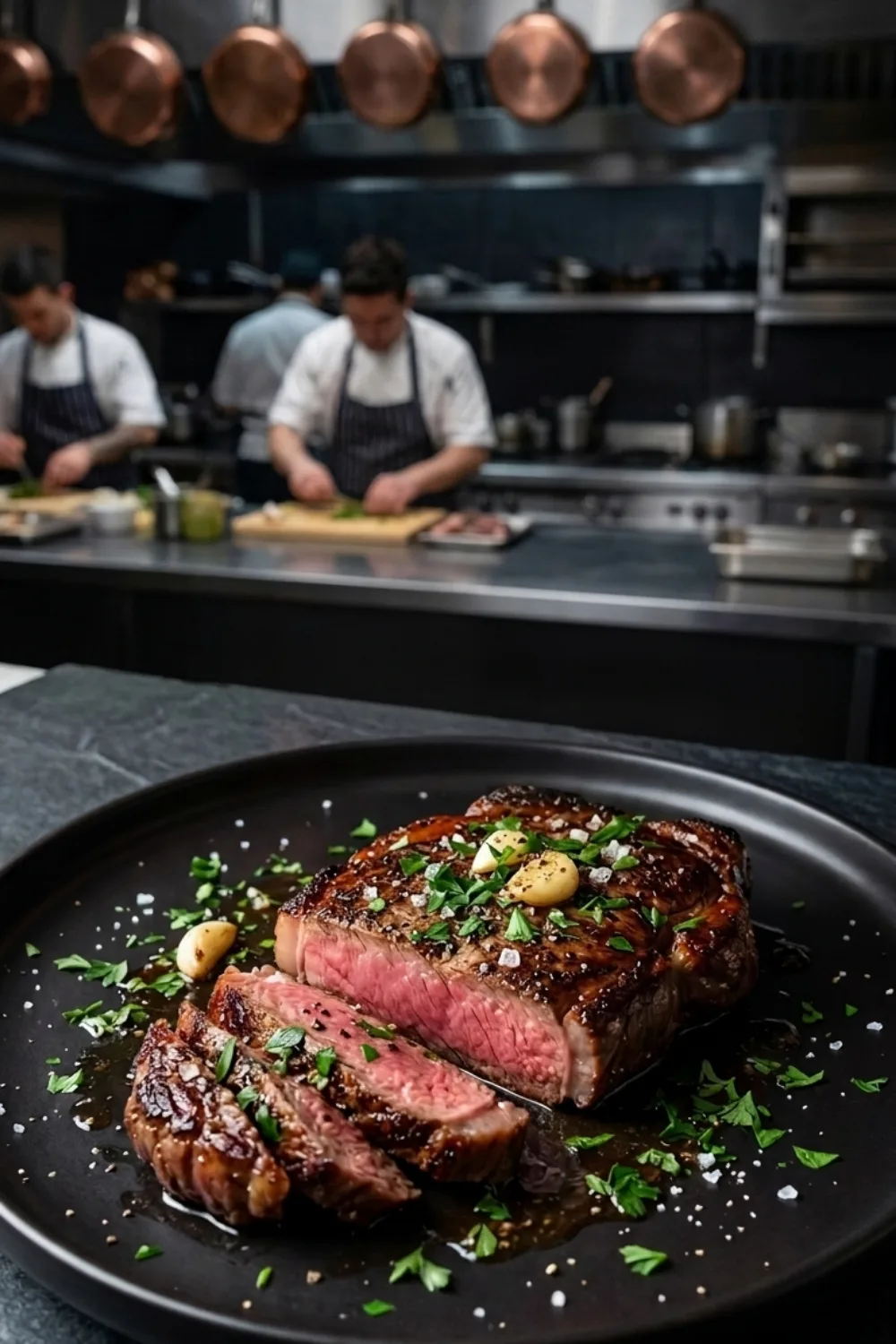
This Gordon Ramsay-style sirloin steak recipe uses a hot pan, a deeply browned crust, garlic-herb butter basting, and proper resting to create a juicy, restaurant-style steak at home. The technique is simple: season the steak well, sear it in a very hot skillet, baste it with butter, garlic, rosemary, and thyme, then let it rest before slicing.
Sirloin is a flavorful, versatile, and generally more affordable steak cut than premium steaks such as ribeye or filet mignon. It works especially well for pan searing because it develops a rich crust quickly while staying tender when cooked carefully.
What Makes a Restaurant-Style Sirloin Steak?
A great pan-seared sirloin steak does not require a complicated marinade or expensive equipment. It depends on a few cooking fundamentals: a good steak, a dry surface, high heat, proper seasoning, butter basting, and resting.
Choosing a Quality Sirloin Steak
Look for top sirloin steaks that are at least 1 to 1½ inches thick. Thicker steaks are easier to sear because they can form a dark brown crust before the center overcooks.
Choose steaks with an even thickness so they cook at the same rate. A small amount of visible marbling is helpful because fat adds flavor and helps the steak remain juicy.
Avoid steaks that look gray, excessively wet, or unevenly cut. If you buy a large sirloin steak, you can slice it after resting and serve it family-style.
Why Pan Temperature Matters for a Good Sear
A hot pan creates the browned outer crust that gives steak its restaurant-style flavor. If the pan is not hot enough, the steak releases moisture and steams instead of searing.
Use a cast-iron skillet, carbon-steel pan, or another heavy-bottomed pan that retains heat well. Preheat it over medium-high heat for several minutes before adding oil.
When the oil looks shimmering and lightly rippling, the pan is ready. Place the steak in the pan carefully, laying it away from you to avoid oil splatter.
The Role of Butter, Garlic, and Fresh Herbs
Garlic, rosemary, thyme, and butter are added after the steak has developed a good sear. Adding them too early can burn the butter and garlic before the steak has browned.
Once the steak is nearly cooked, lower the heat slightly and add butter, smashed garlic cloves, rosemary, and thyme. As the butter foams, tilt the skillet and spoon the aromatic butter over the steak repeatedly.
This process is called butter basting. It adds flavor to the exterior and helps create a glossy, rich finish.
Why Resting Steak Keeps It Juicy
Resting is one of the most important steps in cooking steak. When steak comes off high heat, the juices inside need time to redistribute.
Place the cooked steak on a cutting board or warm plate and rest it loosely covered with foil. For most sirloin steaks, 5 to 10 minutes is enough.
The USDA advises cooking whole cuts of beef such as steaks to a minimum internal temperature of 145°F / 63°C, followed by at least a 3-minute rest before eating.fsis.usda+1
Ingredients and Tools You’ll Need
This pan-seared sirloin steak recipe uses a short ingredient list. Each item supports either a deep crust, a juicy interior, or rich garlic-herb flavor.
Sirloin Steak, Salt, and Black Pepper
Use two top sirloin steaks, each about 8 to 10 ounces and 1 to 1½ inches thick. If your steaks are thinner, reduce the searing time and begin checking the temperature earlier.
Kosher salt and freshly ground black pepper are all you need for basic seasoning. Salt helps bring out the natural beef flavor, while coarse black pepper adds a subtle bite.
For the best result, season both sides of the steaks generously just before cooking.
High Smoke-Point Oil and Butter
Use a high smoke-point oil for searing, such as avocado oil, canola oil, grapeseed oil, or vegetable oil. These oils can handle higher heat better than butter alone.
Butter is added later for basting. Unsalted butter is best because it allows you to control the amount of salt in the finished steak.
Garlic, Rosemary, and Thyme
Use 3 smashed garlic cloves, 2 sprigs of fresh rosemary, and 4 to 6 sprigs of fresh thyme. You do not need to chop the herbs; whole sprigs are easy to remove after basting.
If you do not have fresh herbs, you can omit them. Dried herbs are not recommended for basting because they can burn quickly in the hot butter.
Cast-Iron Skillet and Meat Thermometer
A cast-iron skillet is ideal because it holds heat well and helps form a dark, even crust. A heavy stainless-steel skillet also works.
An instant-read meat thermometer is the most reliable way to cook steak to your preferred doneness. Steak thickness, pan temperature, starting temperature, and stove strength can all change the exact cooking time.
How to Prepare Sirloin Steak for Cooking
A few minutes of preparation make a major difference in the final texture and crust. Do not skip drying the steaks or preheating the pan.
Bring Steak Closer to Room Temperature
Remove the steak from the refrigerator about 20 to 30 minutes before cooking. This reduces the chill on the surface and helps it cook more evenly.
Do not leave raw steak at room temperature for long periods. Prepare the other ingredients while the steak sits briefly, then cook it promptly.
Pat the Steak Dry Before Seasoning
Use paper towels to pat every side of the sirloin steaks very dry. Surface moisture prevents browning and can cause the steak to steam in the pan.
A dry steak, a hot pan, and enough space between steaks are the three most important factors for a strong crust. If you cook more than two steaks, work in batches instead of overcrowding the skillet.
Season Generously with Salt and Pepper
Season the steaks on both sides with kosher salt and freshly ground black pepper. Press the seasoning gently into the surface.
You can add a small amount of garlic powder or smoked paprika if desired, but keep the seasoning simple if you want the steak and herb butter flavors to stand out.
Preheat the Skillet Until Very Hot
Place your cast-iron skillet over medium-high heat for 3 to 5 minutes. Add the oil and wait until it begins to shimmer.
The skillet should be very hot but not producing thick clouds of smoke. If the oil smokes heavily, lower the heat briefly, wipe out the burned oil carefully, and start again with fresh oil.
A high-heat sear followed by garlic-herb butter basting is a widely used pan-seared sirloin method; examples commonly sear for roughly 3 to 4 minutes per side before basting.arorasrecipe+1
How to Pan-Sear and Butter-Baste Sirloin Steak
This technique is best for steaks around 1 to 1½ inches thick. Use the times below only as a starting point—always check the internal temperature for the most accurate result.
Sear the Steak for a Deep Golden Crust
Add oil to the hot skillet. Carefully place the sirloin steaks in the pan, leaving space between them.
Do not move the steaks for about 3 to 4 minutes. Let the contact with the hot pan create a dark golden-brown crust.
If the steak sticks firmly when you try to lift it, give it another 30 to 60 seconds. A properly seared steak will release more easily from the pan.
Flip at the Right Time
Turn the steaks with tongs once the first side has developed a deep brown crust. Sear the second side for another 2 to 4 minutes, depending on the thickness and your target temperature.
Avoid flipping repeatedly. One good sear on each side creates better color and flavor than constantly moving the steak around the pan.
For very thick steaks, briefly sear the fatty edge by holding the steak upright with tongs for 20 to 30 seconds.
Add Butter, Garlic, Rosemary, and Thyme
Lower the heat to medium. Add butter, smashed garlic, rosemary, and thyme to the skillet.
Once the butter melts and starts foaming, tip the pan slightly so the butter pools on one side. Use a large spoon to pour the butter over the steak continuously for 1 to 2 minutes.
If the butter becomes dark too quickly, reduce the heat. You want nutty, fragrant butter—not burned butter.
Baste the Steak with Herb Butter
Continue basting until the steak reaches your desired pull temperature. Remove it from the pan a few degrees before your final target temperature because it continues to cook briefly while resting.
Use an instant-read thermometer inserted into the thickest part of the steak. Avoid touching bone or the pan with the thermometer tip.
For a medium-rare steak, many cooks remove the steak around 130°F / 54°C to 135°F / 57°C and let carryover heat finish it as it rests. However, the USDA minimum food-safety guidance for whole cuts of beef is 145°F / 63°C with a minimum 3-minute rest.fsis.usda+1
Doneness, Resting, and Serving Suggestions
The most reliable method is to use a thermometer, rest the steak, then slice it correctly. This turns a good steak into a tender, restaurant-style meal.
Sirloin Steak Internal Temperature Guide
Use this temperature guide as a practical reference. Temperature preferences vary, but the official minimum safety guidance for whole cuts of beef is 145°F / 63°C plus at least a 3-minute rest.fsis.usda+1
| Doneness | Pull from heat around | Final temperature after resting | Appearance |
|---|---|---|---|
| Rare | 120–125°F / 49–52°C | About 125–130°F / 52–54°C | Cool red center |
| Medium-rare | 130–135°F / 54–57°C | About 135–140°F / 57–60°C | Warm red-pink center |
| Medium | 140–145°F / 60–63°C | About 145–150°F / 63–66°C | Warm pink center |
| Medium-well | 150–155°F / 66–68°C | About 155–160°F / 68–71°C | Slight pink center |
| Well-done | 160°F / 71°C or higher | 160°F / 71°C or higher | Little to no pink |
For food safety, cook steak to at least 145°F / 63°C and allow it to rest for at least 3 minutes before serving.fsis.usda+1
How Long to Rest Steak Before Slicing
Rest sirloin steak for 5 to 10 minutes before slicing. Place it on a cutting board or warm plate and cover it loosely with foil.
Do not wrap steak tightly in foil, because trapped steam can soften the crust you worked hard to create.
During resting, carryover cooking can raise the internal temperature slightly. This is why it is useful to remove steak from the skillet a few degrees before the final temperature you want.
How to Slice Steak Against the Grain
Look closely at the steak to find the direction of the muscle fibers, known as the grain. Cut across those fibers rather than parallel to them.
Slicing against the grain shortens the muscle fibers in each bite, making sirloin steak easier to chew and feel more tender.
For serving, slice the steak into strips and spoon the garlic-herb butter from the skillet over the top.
Best Side Dishes for Sirloin Steak
Serve pan-seared sirloin steak with one starch and one vegetable for a balanced dinner:
- Garlic mashed potatoes
- Crispy roasted potatoes
- Baked potato with sour cream
- Creamy macaroni and cheese
- Roasted broccoli
- Green beans with garlic
- Sautéed mushrooms
- Caesar salad
- Grilled asparagus
- Corn on the cob
A simple steakhouse-style plate could include sliced garlic-butter sirloin, roasted potatoes, and green beans. For a more complete menu, serve the steak with a fresh salad and blackberry upside-down cake for dessert.
Gordon Ramsay-Style Sirloin Steak

Ingredients
- 2 top sirloin steaks 8 to 10 ounces each and 1 to 1½ inches thick
- 1 teaspoon kosher salt plus more to taste
- 1 teaspoon freshly ground black pepper
- 1 tablespoon avocado oil canola oil, grapeseed oil, or vegetable oil
- 3 tablespoons unsalted butter
- 3 garlic cloves lightly smashed
- 2 sprigs fresh rosemary
- 4 sprigs fresh thyme
- Flaky sea salt optional, for serving
Instructions
- Remove the sirloin steaks from the refrigerator 20 to 30 minutes before cooking. Pat the steaks completely dry with paper towels.
- Season both sides of the steaks generously with kosher salt and freshly ground black pepper.
- Heat a cast-iron skillet or heavy-bottomed skillet over medium-high heat for 3 to 5 minutes, until very hot.
- Add the oil and heat until it shimmers.
- Carefully place the steaks in the skillet. Do not move them for 3 to 4 minutes, until a deep golden-brown crust forms.
- Flip the steaks and cook the second side for 2 to 4 minutes, depending on thickness and desired doneness.
- Reduce the heat to medium. Add the butter, smashed garlic, rosemary, and thyme to the skillet.
- When the butter melts and begins to foam, tilt the skillet slightly. Use a spoon to baste the steaks continuously with garlic-herb butter for 1 to 2 minutes.
- Check the internal temperature using an instant-read thermometer. For USDA minimum food safety guidance, cook whole cuts of beef to 145°F / 63°C and rest for at least 3 minutes.
- Transfer the steaks to a cutting board or warm plate. Rest loosely covered with foil for 5 to 10 minutes.
- Slice the steak against the grain. Spoon the garlic-herb butter over the sliced steak and finish with flaky sea salt, if desired.
Notes
- Choose thick steaks: Steaks that are 1 to 1½ inches thick are easier to sear without overcooking the center.
- Dry steak is essential: Patting the steak dry supports better browning and a stronger crust.
- Do not overcrowd the pan: Cook in batches if needed so the skillet stays hot.
- Use high-smoke-point oil: Add butter only after the initial sear to prevent burning.
- No cast-iron skillet? Use a heavy stainless-steel skillet.
- Herb substitution: If you do not have fresh rosemary and thyme, omit them rather than using dried herbs in the hot butter.
- Food safety: The USDA recommends a minimum of 145°F / 63°C for whole cuts of beef, followed by at least 3 minutes of rest.fsis.usda+1
- Leftovers: Refrigerate cooked steak within 2 hours and use within 3 to 4 days. Reheat gently to avoid overcooking.