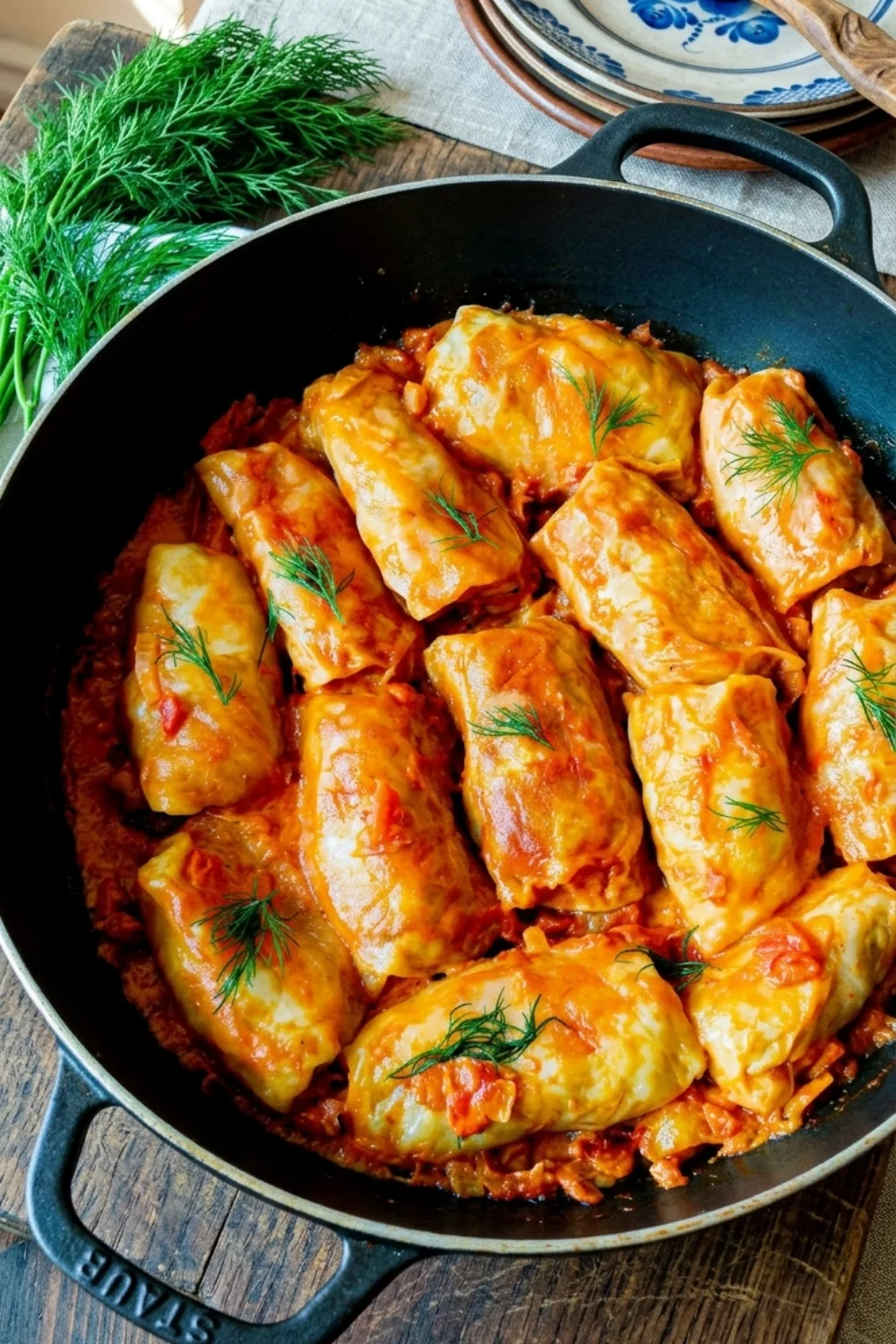
Stuffed Russian cabbage rolls, often called golubtsi or golubtsy, are a comforting Eastern European dish made by wrapping tender cabbage leaves around a seasoned ground meat and rice filling. The rolls are nestled in a savory tomato sauce, then gently baked or braised until the cabbage is soft, the filling is cooked through, and the flavors blend together.
This homemade golubtsi recipe uses green cabbage, ground beef, rice, onion, garlic, and a simple tomato sauce. A little sour cream and fresh dill at serving time add a creamy, tangy finishing touch that pairs beautifully with the rich tomato sauce.
Cabbage rolls take a little time to assemble, but the method is straightforward and the finished dish is ideal for family dinners, holidays, meal prep, or freezer meals. Traditional versions vary from household to household across Russia and Eastern Europe, but cabbage leaves, meat, rice, and tomato-based sauce are common elements.culinariefy+1
What Are Russian Cabbage Rolls?
The meaning of golubtsi and golubtsy
Golubtsi is a Russian term commonly used for stuffed cabbage rolls. You may also see the word written as golubtsy, which is another English transliteration of the same Russian name.
The spelling can vary because Russian words are written in Cyrillic and then converted into English letters. For SEO, it is useful to mention both spellings naturally once or twice in your article:
- Golubtsi
- Golubtsy
- Russian stuffed cabbage rolls
- Russian cabbage rolls
Do not repeat all variations in every paragraph. Use the primary keyword “stuffed Russian cabbage rolls” in your title, introduction, recipe card, and a natural heading, then use “golubtsi” in the cultural and recipe-description sections.
A traditional Eastern European comfort food
Russian cabbage rolls are a classic comfort-food meal. The cabbage becomes soft and delicate during cooking, while the meat-and-rice filling turns tender and flavorful in the tomato sauce.
They are often served for family gatherings, special occasions, and cozy home dinners. One source describes golubtsi as a Russian dish associated with special occasions, while other contemporary recipe references describe tender cabbage leaves filled with beef or pork, rice, onion, and garlic, then simmered in tomato sauce.culinariefy+1
Like many traditional recipes, every family may have a different method. Some cooks use ground beef, while others use pork, turkey, chicken, or a combination of meats. Some sauces include sour cream, carrots, tomato paste, broth, or herbs such as dill and parsley.
How Russian cabbage rolls are usually made
The process has four main parts. First, soften cabbage leaves so they are flexible enough to roll without tearing. Second, prepare a filling with ground meat, partially cooked rice, onion, garlic, and seasonings.
Third, place a small portion of filling inside each cabbage leaf, fold in the sides, and roll it into a neat parcel. Finally, arrange the rolls seam-side down in tomato sauce and bake or simmer them slowly until the cabbage and filling are tender.
Cooking the rolls slowly in sauce gives them their comforting flavor. The sauce soaks into the cabbage and rice, making the entire dish tender, rich, and satisfying.
Golubtsi compared with Polish golabki
Golubtsi are closely related to many stuffed cabbage dishes across Eastern Europe. Polish gołąbki, Ukrainian holubtsi, Romanian sarmale, and other cabbage-roll recipes share a similar idea: cabbage leaves wrapped around a filling and cooked slowly.
The differences are usually found in the details. Recipes may use different types of meat, rice, grains, herbs, sauces, or cooking methods. Some versions use sauerkraut cabbage, some bake the rolls in a creamy tomato sauce, and others simmer them in broth.
For this recipe, the focus is on a Russian-inspired golubtsi style: green cabbage, beef and rice filling, tomato sauce, and optional sour cream and dill for serving.
Ingredients for Stuffed Russian Cabbage Rolls
Green cabbage leaves for wrapping
A large head of green cabbage is the traditional choice for these stuffed Russian cabbage rolls. Look for a cabbage with broad, flexible outer leaves. These are easier to fill and roll than very tight or small leaves.
You will need around 12 to 14 large cabbage leaves for this recipe. The outer leaves usually work best, but you can also carefully remove and soften inner leaves as you work.
To prepare cabbage leaves, cut around the core with a sharp knife. Place the whole cabbage head in boiling water, then remove the softened outer leaves one at a time with tongs. Trim the thick center rib near the base of each leaf so it lies flatter and rolls more easily.
Ground beef, pork, or a meat mixture
Ground beef makes a flavorful, familiar filling. Use lean ground beef, such as 85% to 90% lean, so the filling stays juicy without becoming excessively greasy.
A combination of ground beef and ground pork is also traditional in many cabbage-roll recipes. Pork adds richness and tenderness. You can use half beef and half pork, or replace the beef completely with ground turkey or ground chicken for a lighter version.
Make sure the meat is mixed thoroughly with the rice, onion, garlic, egg, and seasonings. This helps the filling cook evenly inside the cabbage leaves.
Rice, onion, garlic, and herbs
Use long-grain white rice for the most classic texture. Par-cook the rice before mixing it with raw ground meat. The rice should be only partly cooked, not fully soft, because it continues cooking while the cabbage rolls bake in sauce.
Finely diced onion and minced garlic flavor the filling. Fresh dill is optional but gives the dish a fresh, traditional herbal note. Parsley can be used if you do not have dill.
An egg helps bind the meat and rice filling, making it easier to roll and helping the filling hold together after cooking. Season the mixture with salt, black pepper, and a little paprika.
Tomato sauce, tomato paste, and sour cream
The tomato sauce is simple but flavorful. Onion, carrot, garlic, tomato sauce, tomato paste, broth, paprika, and a small amount of sugar create a savory sauce with gentle sweetness and acidity.
Tomato paste deepens the tomato flavor, while broth makes enough sauce to surround the cabbage rolls as they cook. The sauce should be loose enough to simmer around the rolls but not so watery that it lacks flavor.
Sour cream is optional, but it is delicious spooned over the cooked golubtsi. You can also stir a little sour cream into individual portions of sauce. If you prefer, use plain Greek yogurt instead.
How to Make Russian Cabbage Rolls
Soften cabbage leaves without tearing them
Bring a large pot of water to a boil. Carefully cut around the cabbage core with a sharp knife, but do not cut all the way through the head.
Lower the whole cabbage into the boiling water. Let it cook for about 3 to 5 minutes, then use tongs to gently peel off the softened outer leaves. Return the cabbage to the water and repeat until you have 12 to 14 leaves.
Place the softened leaves on a clean kitchen towel or cutting board. Use a small knife to shave down the thick center rib at the base of each leaf. Do not cut through the leaf; simply make the thick rib thinner and flatter so it is easier to roll.
Prepare the meat and rice filling
Bring a small saucepan of water to a boil. Add the rice and cook it for about 7 minutes, until partly tender but not fully cooked. Drain well and let it cool slightly.
In a large bowl, combine the ground beef, par-cooked rice, finely diced onion, minced garlic, egg, fresh dill, salt, black pepper, and paprika. Mix gently with a spoon or clean hands until all ingredients are evenly combined.
Do not overmix the filling. Overmixing can make ground meat dense. The mixture should be moist enough to hold together when you scoop it, but not wet or loose.
Roll and arrange the stuffed cabbage leaves
Place one cabbage leaf on a clean work surface with the stem end closest to you. Spoon about 3 tablespoons of filling near the base of the leaf.
Fold the bottom of the cabbage leaf over the filling. Fold in the left and right sides, then roll upward tightly, like a burrito. The roll should be snug but not overly tight because the rice needs a little room to expand during cooking.
Spread a small amount of tomato sauce on the bottom of a large Dutch oven or 9-by-13-inch baking dish. Arrange the cabbage rolls seam-side down in a single layer. Place them close together so they support one another and do not unroll while cooking.
Simmer or bake cabbage rolls in tomato sauce
To make the sauce, sauté onion and carrot in olive oil until soft. Add garlic, tomato sauce, tomato paste, broth, paprika, sugar, salt, and pepper. Simmer for a few minutes so the flavors combine.
Pour the sauce over the cabbage rolls. The rolls should be mostly covered, but they do not need to be completely submerged. Cover the dish tightly with a lid or foil.
Bake at 375°F / 190°C for 60 to 70 minutes, until the cabbage is very tender, the rice is cooked, and the center of the filling is fully cooked. Let the dish rest for 10 minutes before serving so the sauce thickens slightly.
Tips, Variations, and Common Questions
Should rice be cooked before making cabbage rolls?
Yes, but only partially. Par-cooking the rice for about 7 minutes gives it a head start, while allowing it to finish cooking in the tomato sauce inside the cabbage rolls.
If you use completely raw rice, it may not become tender by the time the cabbage and meat are cooked. If you use fully cooked rice, it can become overly soft after the rolls bake for an hour.
The best middle ground is partially cooked rice that is still firm in the center. It will absorb flavor from the tomato sauce as the cabbage rolls cook.
How to keep cabbage rolls from falling apart
Use cabbage leaves that are softened but still intact. Trim the thick rib so the leaf can fold easily, but do not cut holes in the leaves.
Roll the cabbage tightly enough to enclose the filling, then place every roll seam-side down in the sauce. Arrange the rolls close together in the pan so they support one another.
Keep the baking dish covered during most of the cooking time. The steam helps soften the cabbage and keeps the rolls tender. Do not stir the rolls while they cook because moving them too much can cause them to open.
Make cabbage rolls with turkey or vegetarian filling
For turkey cabbage rolls, use ground turkey instead of ground beef. Because turkey is leaner, add 1 tablespoon olive oil to the filling or use a mix of ground turkey and turkey sausage for more flavor.
For vegetarian stuffed cabbage rolls, replace the meat with cooked lentils, finely chopped mushrooms, or a mixture of rice, beans, grated carrots, and mushrooms. Use vegetable broth in the sauce and serve with sour cream or dairy-free yogurt if desired.
You can also use cauliflower rice for part of the filling, but do not replace all the rice with cauliflower rice because it releases more moisture during cooking.
Use leftover cabbage leaves and filling
If you have leftover cabbage leaves but no filling, slice the leaves and sauté them with onion, garlic, butter or olive oil, salt, pepper, and a splash of broth. This makes a simple cabbage side dish.
If you have leftover meat-and-rice filling, shape it into small meatballs and bake or simmer them in the remaining tomato sauce. This creates a quick “unstuffed cabbage roll” dinner without needing to roll more leaves.
Leftover tomato sauce can be served over mashed potatoes, rice, noodles, or roasted vegetables.
Serving, Storage, and Freezing
What to serve with Russian cabbage rolls
Stuffed Russian cabbage rolls are a filling main dish, but simple sides complete the meal. Serve them with rye bread, crusty bread, boiled potatoes, mashed potatoes, buttered noodles, or buckwheat.
A dollop of sour cream and fresh dill are classic toppings. For vegetables, serve cucumber salad, beet salad, pickled vegetables, roasted carrots, or a simple green salad with light vinaigrette.
The extra tomato sauce is delicious spooned over the cabbage rolls and any side dish you serve alongside them.
How to store leftover golubtsi
Allow the cabbage rolls and sauce to cool slightly, then transfer them to shallow airtight containers. Refrigerate promptly and store at 40°F / 4°C or below.
Meat-containing cooked leftovers are generally best used within 3 to 4 days when refrigerated properly. Reheat individual cabbage rolls in the microwave, covered, with a spoonful of sauce. You can also reheat them in a covered baking dish at 350°F / 175°C until hot throughout.foodsafety+1
Can you freeze stuffed cabbage rolls?
Yes. Russian cabbage rolls are an excellent freezer meal. You can freeze them cooked or uncooked.
To freeze cooked cabbage rolls, cool them completely, arrange them in freezer-safe containers with sauce, and freeze for up to 2 to 3 months for best quality. Thaw overnight in the refrigerator, then reheat covered in the oven until hot throughout.
To freeze uncooked cabbage rolls, assemble them, arrange them in a freezer-safe baking dish, cover with sauce, and freeze tightly. Thaw overnight before baking. You may need to add 10 to 15 minutes to the baking time if the dish is still very cold when it goes into the oven
How to reheat cabbage rolls in tomato sauce
For the oven method, place cabbage rolls and sauce in a covered baking dish. Reheat at 350°F / 175°C for about 20 to 25 minutes, or until hot throughout.
For the stovetop method, place the rolls in a wide pan with sauce. Cover and heat over low to medium-low heat, turning the heat down if the sauce begins to stick.
For the microwave method, place one or two rolls in a microwave-safe dish with sauce. Cover loosely and heat in short intervals, turning the roll once if necessary, until thoroughly hot.
Recipe Summary
These stuffed Russian cabbage rolls, also known as golubtsi or golubtsy, are tender green cabbage leaves filled with seasoned ground beef, par-cooked rice, onion, garlic, and dill. The rolls are baked in a savory tomato sauce and served with sour cream and fresh herbs for a comforting Eastern European-inspired family meal.

Stuffed Russian Cabbage Rolls

Ingredients
For the cabbage rolls
- 1 large head green cabbage
- ¾ cup uncooked long-grain white rice
- 1 pound lean ground beef 85% to 90% lean
- 1 small yellow onion very finely diced
- 3 garlic cloves minced
- 1 large egg
- 2 tablespoons chopped fresh dill plus more for serving
- 1 teaspoon salt
- ½ teaspoon black pepper
- ½ teaspoon paprika
For the tomato sauce
- 1 tablespoon olive oil
- 1 small yellow onion finely diced
- 1 medium carrot grated
- 2 garlic cloves minced
- 2 cups tomato sauce
- 2 tablespoons tomato paste
- 1 cup low-sodium beef broth chicken broth, or vegetable broth
- 1 teaspoon paprika
- 1 teaspoon sugar
- ½ teaspoon salt plus more to taste
- ¼ teaspoon black pepper
- ½ cup sour cream or plain Greek yogurt optional, for serving
- Fresh dill or parsley optional, for serving
Instructions
- Preheat the oven to 375°F / 190°C.
- Bring a large pot of water to a boil. Carefully cut around the core of the cabbage with a sharp knife.
- Place the cabbage head in the boiling water. Cook for 3 to 5 minutes, then use tongs to gently remove softened outer leaves. Repeat until you have 12 to 14 large leaves.
- Lay the cabbage leaves on a clean work surface. Use a small knife to shave down the thick rib at the base of each leaf so it lies flat and is easier to roll.
- Bring a small saucepan of water to a boil. Add the rice and cook for 7 minutes, until partially cooked. Drain well and let cool slightly.
- In a large bowl, combine the par-cooked rice, ground beef, diced onion, minced garlic, egg, dill, salt, black pepper, and paprika. Mix gently until evenly combined.
- Heat 1 tablespoon olive oil in a saucepan over medium heat. Add the onion and grated carrot. Cook for 5 minutes, until softened.
- Add the garlic and cook for 30 seconds. Stir in tomato sauce, tomato paste, broth, paprika, sugar, salt, and black pepper. Simmer for 5 minutes, then remove from the heat.
- Spread about 1 cup of tomato sauce in the bottom of a large Dutch oven or 9-by-13-inch baking dish.
- Place about 3 tablespoons of filling near the base of one cabbage leaf. Fold the bottom over the filling, fold in the sides, and roll tightly. Repeat with the remaining cabbage leaves and filling.
- Arrange the cabbage rolls seam-side down in the prepared dish. Place them close together so they stay closed while baking.
- Pour the remaining tomato sauce evenly over the cabbage rolls. Cover tightly with a lid or aluminum foil.
- Bake for 60 to 70 minutes, until the cabbage is tender, the rice is fully cooked, and the filling is cooked through.
- Let the cabbage rolls rest for 10 minutes before serving. Spoon tomato sauce over each portion and serve with sour cream and fresh dill if desired.
Notes
- Mention both golubtsi and golubtsy naturally in the article for readers searching either English spelling.
- Use half ground beef and half ground pork for a richer filling.
- Replace ground beef with ground turkey for a lighter version; add 1 tablespoon olive oil to the filling if the meat is very lean.
- Use vegetable broth and a filling made with lentils, mushrooms, rice, and grated carrots for a vegetarian version.
- Par-cook the rice for about 7 minutes. Fully cooked rice may become too soft, while fully raw rice may not cook evenly inside the rolls.
- Put each cabbage roll seam-side down and keep the pan covered to prevent the rolls from opening or drying out.
- Refrigerate leftovers promptly in airtight containers and enjoy within 3 to 4 days.
- Freeze cooked cabbage rolls in their sauce for up to 2 to 3 months for best quality.